

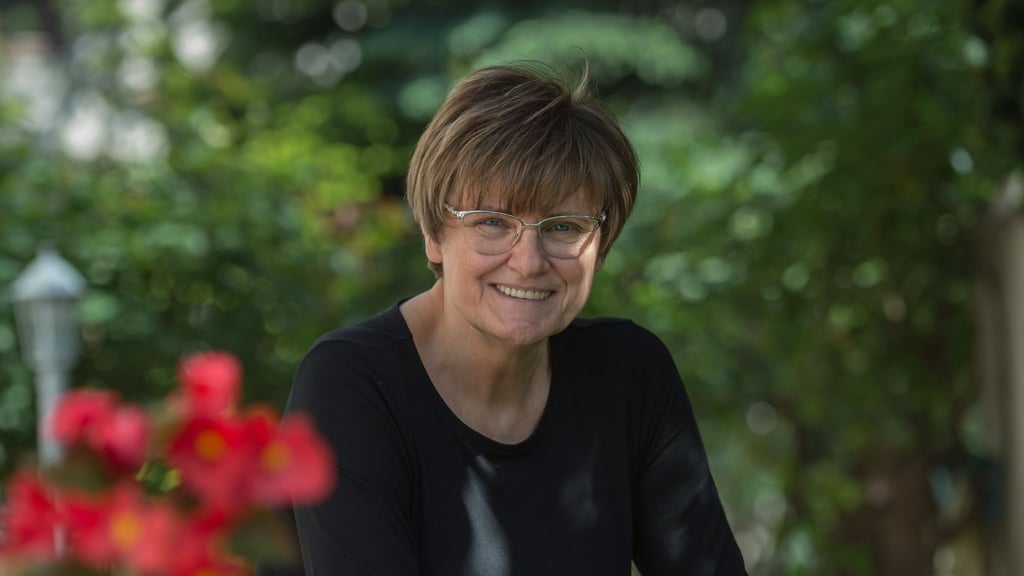

Katalin Karikó is now a superstar: when the Hungarian-American biochemist and Nobel Prize laureate gives a lecture anywhere in the world, she fills halls with thousands of listeners. She is celebrated with minutes-long applause for her role in developing the mRNA vaccine against the coronavirus. And even in usually reserved Switzerland, some audience members literally fell to their knees before her, as seen during her last appearance in Basel when she went into the crowd and signed autographs. The 70-year-old is also the subject of several children’s books and receives fan mail from all over the world every – as if she were a pop star.
Such admiration for a 70-year-old scientist who has spent her entire life working in a lab hasn’t been seen since Marie Curie. But where does this popularity come from, a level of fame that other Nobel Prize winners in Medicine like Julius (2021), Houghton (2020), or Semenza (2019) can only dream of?
She Was Never Supposed to Succeed
The answer lies in Karikó’s life story – one that even Steven Spielberg couldn’t have written more dramatically. Her journey is marked by seemingly insurmountable obstacles. By any rational measure, she should never have succeeded. And yet here she sits, in a modest family home in the U.S., a highly decorated scientist with more than 200 awards and a daughter who is herself a two-time Olympic champion – reflecting on the beginnings of her life with us.
Katalin Karikó was born in 1955 into a working-class family in communist Hungary. Her father was the local butcher in the small village of Kisújszállás until he lost his job at the state-run butcher shop due to political persecution, forcing the family at times to survive on day labor. Her mother occasionally worked as a bookkeeper to earn a little extra money. The family lived in a one-room house made of earth bricks that was already in dire need of repair. Later, it would be replaced by a new house that the Karikós built themselves over a summer – using old bronze nails they salvaged from the rubble of a neighboring house.
Article series
Miracle Molecule mRNA – Katalin Karikó’s Legacy
No other method holds as much potential to revolutionize medicine as mRNA technology. The mRNA research, significantly shaped by the Hungarian-American biochemist Katalin Karikó, has doctors dreaming of curing infectious diseases, genetic disorders, and cancer within the coming years. In this series, we highlight projects by leading researchers who, building on Karikó’s work, are introducing mRNA technology into various fields of medicine.
Looking back, Karikó describes this early time as idyllic in her autobiography. She and her sister, she writes, had everything they needed to be happy. They tended the vegetable garden, fed the chickens, and were given responsibilities early on by their parents: fetching water from the well each morning in a large bucket for the family’s daily use or protecting the garden plants from hungry insects. One of her greatest joys was when her father would turn fresh cuts of meat into traditional Hungarian smoked sausages.

Katalin Karikó as a child in 1957 and with her parents in 1979.
«In those years, my interest in science was first ignited,» Karikó recalls. Even a simple rural life was filled with biology and chemistry. She watched neighbors make soap using chemicals, her father explained animal anatomy to her during slaughtering, and she identified countless wild plants by name thanks to her grandmother’s knowledge. In fifth grade, she received a botany book illustrated by botanist Vera Csapody, which she soon knew by heart and carried with her for hours through the countryside.

A simple but happy life: The future researcher (third from left) with school friends.
The Communists Strike Twice
Though she initially had some struggles in school Karikó’s perseverance quickly set her apart. She studied relentlessly, eventually catching up to and surpassing her peers to become the top student by the end of primary school. This was no small feat at a time when children were regularly pulled out of class during harvest season to work in the fields, a challenge especially for kids from non-academic families. Karikó also battled recurring health issues and spent time in hospitals. «You’re not eating enough, child,» her mother would scold her.
A turning point came when Karikó won a local biology competition and was invited to participate in a communist party–sponsored program, eventually placing third overall – thanks in part to her superior knowledge of plants, an advantage she owed to her simple rural upbringing. This achievement paved her way to the university in Szeged, where she narrowly secured one of just 18 coveted biology program spots.
Karikó’s university years were happy ones. She quickly formed a close-knit group of friends in the dormitory and supported herself by working alongside her studies – including grape harvesting. During this time, she met her future husband, Béla Francia, who would remain by her side through all of life’s challenges.

Studies completed: Kati Karikó (third from left, front row) at her graduation ceremony in 1978.
In 1978, she graduated and began her doctoral research, focusing for the first time on producing RNA in the lab. The work was grueling: communist Hungary often lacked essential chemicals. Resourceful as ever, Karikó improvised, creating missing substances from others. In 1982, she also became a mother, caring for her daughter Susan while continuing her research.
Then, the communist regime intruded into her life in the most menacing way. The secret police approached Karikó, pressuring her to spy on dissidents at the university – warning that her parents would suffer if she refused. She reluctantly agreed on paper but never reported a single name. Karikó was apolitical, far more interested in unraveling the mysteries of biochemistry than politics. Perhaps as a result, her position was suddenly defunded in 1985.
Off to the U.S. for a meager wage
Desperate, Karikó reached out to American researchers, knowing that the best RNA and DNA publications came from the U.S. Eventually, she was offered a postdoctoral position at Temple University in Philadelphia with a yearly salary of $17,000.
The family risked everything to emigrate. To evade customs officials, Karikó sewed the little savings they had into her daughter’s teddy bear. And so, the Karikós crossed the Iron Curtain and landed in the bustling chaos of an American metropolis.

With her husband Béla and daughter Susan, the researcher gradually settles into life in the U.S.
At first, Karikó clashed with the rigid hierarchies of American universities. Her supervisor, Professor Suhadolnik, was notoriously volatile. Even though she managed better than some colleagues, his frequent outbursts took their toll. After three years, she accepted an offer to move to another university. In retaliation, her boss immediately fired her and reported her to immigration authorities, declaring she was now jobless and should be deported.
Fortunately, Karikó’s growing expertise in the human immune system quickly landed her a position in cancer research at a U.S. Army–affiliated university. But the job was three hours away, forcing her to live apart from her family during the week. Many nights, she slept in a sleeping bag on the laboratory floor or on a family friend’s couch – there was no money for proper accommodation.

A place where Karikó feels at home: one of the labs where she has spent half her life dedicated to science.
The separation from her husband and young daughter weighed heavily on her. She applied constantly for jobs in Philadelphia until, in 1989, she was hired by Elliot Barnathan at the University of Pennsylvania – one of the top five universities in the U.S. and alma mater to the likes of Donald Trump and Elon Musk.
She is considered «difficult» and too direct
Karikó began to make a name for herself in the niche world of mRNA research. Colleagues dubbed her the «crazy mRNA lady» because she couldn’t stop talking about the potential of messenger RNA. While every human cell naturally produces mRNA – a vital molecule – attempts to create therapeutic mRNA in the lab all failed, triggering dangerous immune reactions. Unlike most researchers, Karikó remained convinced that the technology had enormous potential, if only the inflammatory response problem could be solved.
But her directness caused friction. When the son of a prominent professor botched an experiment by not following instructions, Karikó scolded him and tossed the ruined Petri dish into the trash in front of everyone. Soon after, she herself was called into her boss’s office after anonymous complaints about her strictness with students.
What she didn’t know at the time: the very student she had just reprimanded would one day surprise her in ways she could not have imagined.
Part 2 of the series can be found here .
Note
* This article series has been nominated for the Prix Média Newcomer 2025 and was supported by the Swiss Academy of Sciences.


