


The Noble Prize committee had a lot of explaining to do last year, when they didn’t choose Hungarian-American biochemist Katalin Karikó and her colleagues as awardees. Their ground-breaking research led to the development of mRNA-vaccines against the SARS-CoV-2-Virus and is currently used to find a way to prevent other infectious diseases or treat cancer.
Therefore, it is no surprise that Karikó and Co are again the favourites for winning the Nobel Prize this year. In the beginning of October, Karikó will also come to Switzerland to receive several honours, among them the Louis-Jeantet Prize, which is endowed with 1.4 million francs, and an honorary doctorate from the University of Geneva. We spoke with the amicable professor, who lets everyone still call her by her nickname «Kati».
You have received more than 75 awards this year, the number will go up to a 100 at the end of the year. How important are those prizes for you as a scientist?
Katalin Karikó: These prizes are mainly important in the way that they put science in the public spotlight and emphasize its importance. For me personally it also feels like an incredible privilege, especially when I look back at those who received these prizes before me. It humbles me to realize that I am listed there with those legendary scientists who I respect so much.
With those awards comes funding and attention that you can use for further research. Do you think money is distributed the right way?
This is a very difficult topic. I didn’t get the funding for projects on mRNA-research for most of my career. Now that the subject is considered more important, there was even a study done in the Harvard Business Review that tried to find out why I never got money in the past. They said it was because I came from a «Who-knows»-University [Szeged in Hungary], I didn’t have a well-known mentor and in addition the sponsors just thought «She is doing something weird, why should we give her money?» On top of that, I was not considered faculty quality, because I didn’t have a first author publication in Nature and didn’t have an Ivy League education. And these are the things you must have to be somebody, that is how it is today.
About
Katalin Karikó – the woman with three careers
Hungarian-American scientist Katalin Karikó became famous for her contribution to the develpement of the mRNA-vaccine. She began working as a young scientist at the University of Szeged. Later, she moved to the US as an adjunct professor, where she worked for nearly 30 years. After her academic retirement in 2013, she became vice president at Biontech in Germany. Karikó is married and mother of an adult daughter. She lives in the US. (smr)
So is there too much emphasis on the big names, on publishing in the right science journals?
The issue is that all the money and prestige are very centralized in the world of science. If you are not close to that centre, you have no money, no fame and no prestige. Recently I talked to a scientist in charge of evaluating grant proposals and she told me that she tries to find the «Karikó» applications that are outliers and unconventional.
The people in charge are the problem then?
It’s not that easy. The scientists who evaluate the proposals are on countless committees, they have an incredible number of responsibilities. They are required to read papers, write papers, manage their laboratories and much more. Therefore, these decision makers only have limited time to read grant proposals. When an unfamiliar approach or research tool is proposed - like in my case projects with mRNA – the chance increases that they eliminate it. After all, 90% of proposals are rejected anyways. Today, easily understandable proposals are more likely to get funded.
How could this process be improved?
More time and an effort to really understand proposals would be helpful, including from fields that are not in the mainstream. But you should remember that there can also be an upside to rejected proposals: You have the freedom to do something very different than everyone else, even though possibly in a smaller way. I certainly wouldn’t be where I am today without the hardships I experienced because they made me more resilient.
There are still fewer women in STEM fields than men. Did you ever feel discriminated against because you are a woman?
I did not feel like my fellow scientists looked down on me. Maybe they said things behind my back which I never heard, but I didn’t care. The thing today is: At the universities, as students, women are sometimes even overrepresented. But after graduation, as soon as they give birth and become mothers, they fall behind and don’t end up in leadership positions. This is also a problem because of the low salary of scientists. If a family does not earn enough to hire a nanny, female scientists will give up their profession. That is a huge loss for the individual person and for society.
What could be done about that?
I want to emphasize the importance of high quality and affordable childcare. That is something that was very well managed when I was a young scientist in Hungary. You paid a nominal fee and got good care. Even registered nurses were among the care takers of your child. Also, everyday a paediatrician would come to the facility, and you could write any questions concerning your child in a booklet, and the paediatrician would answer them. Knowing that my child is safe and well cared for helped me to stay focused at work.

Karikó with her family in the US in 1987. Her daughter has become a two time Olympic gold medalist rower.
I see. But in most countries today such services are not available.
Yes, and therefore a lot of women give up their careers to stay at home. I’ve heard the sentence «I will sacrifice my life for my children» countless times. But that is the wrong approach: Even though a lot of women feel like they must do that and be there for their children, they shouldn’t give up their dreams for it! You shouldn’t use your children as an excuse to give up your career, they are as much your husband’s responsibility. My key advice to young women is to find a partner who appreciates and respects that, if you want to continue to pursue achievements in science.
A related problem is that women are often paid less in similar positions. Was that ever the case with you?
Of course, but I never cared about that. This is something that you will also experience as a young man. You will find that after specializing in something, there will always be a colleague who works less, who is promoted before you or who makes more money than you. That makes a lot of people feel disappointed, especially now that society is more egocentric. But I tell you that if you pay attention to that, you pay less attention to things that you can change. Everything must end with the question: What can I personally do better? Because your circumstances often cannot be changed. And discrimination is not the only problem in the scientific world right now.
What else is?
Every year fewer students want to study science. That is because scientists are unlikely to earn a good salary. Also, most people today need validation for their work and if they don’t get it, they give up easily. In the US, you could see that especially well during the pandemic. A lot of mid-level professors said, «I worked long hours, writing papers and grants to support my team and this process gives me no satisfaction,» and they left their fields. But we need minds that help to explore complex biology, discover the molecular mechanisms of many diseases.
That is probably hard for a lot of people.
Yes, science is not very family friendly, it sucks you in completely and is not a nine-to-five job. As a scientist, you think about your work constantly, even if you are waiting in the line in the «Netto»-supermarket and you try to understand the foundation of your research subject. If you like that, it can be very fulfilling to be a scientist.

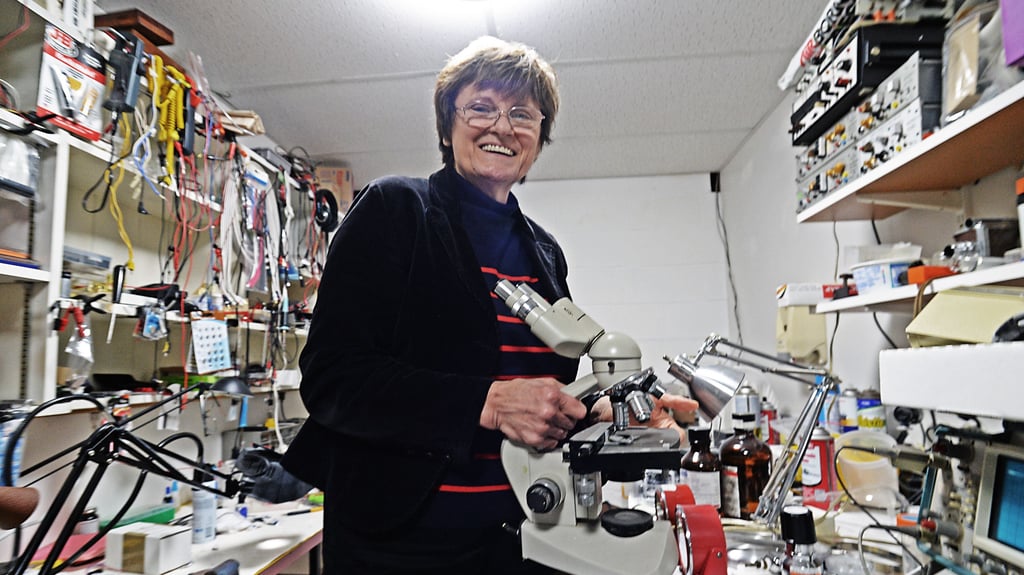
Karikó did ground work in the lab for decades without being acknowledged by the scientific establishment. The picture was taken in the late 80ies.
What was the hardest moment in your career?
Probably coming to Germany when I was 58 years old, after I had retired from the university to work as Vice President at Biontech. I left my husband and our house in the United States and then I was alone in Germany in a small apartment, in an attic. In the first week I thought «I have a house with a one-acre wood and a husband waiting in the US, and now I’m here living out of a suitcase». There was only one washing machine in the basement, and that was so dirty that I had to clean it for half a day. During the first week I fell asleep every night crying, and I thought I had made a big mistake. But then after that week, I got so busy, I just fell asleep and didn’t have the time to cry anymore. It got better fast.
What advice would you give to young scientists?
You must have a goal as a scientist. It shouldn’t be to get a certain tenured position, or other titles, but to really research and understand a detailed mechanism in a field of science. This is something that a lot of people get wrong. If you publish papers – more is better - it can help you get a promotion, more grants, a larger team. However, if another scientist scoops you by publishing something similar like what you were working on, you feel devastated. If your goal is purely scientific, you will not be upset, instead rather happy that there is more data and maybe you will even get validation for your theory. But when I talk to other scientists, the reality is, that most are upset if somebody publishes anything before them.

In her old homeland, Karikó has reached the status of a legend. A big portrait of her can be found on a wall in the city of Budapest.
A problem for science is that its credibility is eroding. That was especially the case during the pandemic, when debated which approach is better, the relaxed one or the restrictive one. What would have been the right way to handle Covid?
In hindsight, it is easy to see what should have been done differently, but we learn from those mistakes and next time the communication will be better. I think the public would have followed recommendations better if the health experts would just have told them what we did and didn’t know about the virus and the infection mechanisms and based on that explained the preventive measures. Since it was not done properly, certain things had to be taken back and that led to mistrust. Communicating science should be improved.
Today, a career in science does not seem that attractive for young people. Of the 50 most followed people on Twitter, only Elon Musk and Bill Gates have something to do with it, the rest are sportsters, actors, and singers. Do you think society values science enough?
Counterquestion: Why do you think that people are more interested in what the Kardashians are doing than what any of the scientists are? Why is it that even seriously ill patients taking their medications never ask who invented their lifesaving pills? If you ask people on the street to name a scientist, they will say «Einstein”! Then you follow up with “And somebody who is still alive today?» and there is no answer. I think there should be more about science in the media.
As devil’s advocate I would say people just click more on articles about famous people.
I don’t think that is the case, it is an unanswerable question like «What was first, the chicken or the egg?». The media is full of reports about every detail of celebrities’ lives, so this is what the public gets, because the media assumes that this is what everybody is interested in. But you would have to tell the stories of the exciting scientific discoveries in a way that the public can easily understand them.
Despite always working, you have managed to successfully raise your daughter, she won the gold medal in rowing at the Olympic Games and lives in San Diego. What is your most important advice for struggling parents?
I think you should inspire your children to do interesting and important things that make them happy and that are worth dedicating their life to. You shouldn’t over-assist them in their daily activities, as they need to learn responsibilities. Our daughter as a schoolgirl did her chores at home, like vacuuming the house. Of course, children should have time to play, but its good if they learn things about life while doing that. It makes children proud too if they can contribute to the family in that way.

Katalin Karikó (left) with her daughter Susan Francia at the Olympic Games in Beijing, at which she won gold.
Is it still a good idea for young people who want to have a career to go to the United States?
I would say definitely yes, but I’m sure it would also help if you would work in a different country within Europe. By living in a new country, you learn so much about another culture, and about yourself as well. I saw it myself; I became more relaxed and tolerant.
As a scientist, you must be extremely rational most of the time. Do you believe in religion?
I was raised without any religion, but I worked with colleagues who followed different religions. Sometimes I think it would be really comforting to believe in something, like that my parents are looking at us from above, and we would meet them after our life on earth. But I don’t believe that. However, I believe that my parents are with me not just because of the genes I inherited from them, but because of the way they raised me.


